Feeds:
Posts
Comments

Posts Tagged ‘insulin’


Hi,

I just wanted to share some info regarding blood glucose meters and a superb company called Menarini Diagnostics who have a range of blood glucose meters called GlucoMen (LX PLUS and GM) which I have been using for a while now and found them easy to use, the customer support team have also been very helpful.

Here is a little bit of company info about Menarini:

Menarini Diagnostics was established in the UK during 1987. The company is now established as one of the fastest growing diagnostics companies in the UK with annual growth in excess of 20%. To date Menarini has already placed more than 700 analysers of various types in the UK market. MDUK are market leaders in the field of diabetes diagnostics, with leading edge systems for HbA1c, blood glucose and continuous glucose monitoring.

Nearly 60% of all HbA1cs in the UK are performed on our lab systems. That’s more than 1 million people relying on MDUK HbA1c systems every year. Over 1 million self tests are performed on GlucoMen blood glucose meters every day across Europe.

MDUK’s goal is to work closely with all Diabetes Specialist Nurses and patients, and continue to do the right things to support the growing number of people who choose to rely on the
GlucoMen LX systems to help manage their diabetes at home.

20120804-104345.jpg

I have been using the Glucomen LX PLUS for a while now and when I first received the meter it was in a lovely gold box so also a little bit of bling (ha ha), anyway sorry back to my thoughts…..

20120806-122534.jpg

MDUK’s GlucoMen LX PLUS is a blood glucose meter that incorporates a 2-in-1 blood glucose and ketone testing facility.

The ketone testing is particularly useful for insulin users and those who may wish to test their blood ketone levels.

GlucoMen LX PLUS meter advantages

The GlucoMen LX PLUS is a no coding meter that provides:
** Pain free with a unique lancet introducing comfort zone technology
** Blood test results in 4 seconds
** Coloured covers to personalize your device – hmmm funky.
** 0.3 microlitre sample for easy and comfortable testing
** Meal markers for controlling your diabetes
** The device has a rubber grip, which makes it easy to use and prevents it sliding off surfaces.

Alternative site testing is available for blood glucose tests however ketone testing should be done on the fingers alone.

The GlucoJect Dual S lancing device that comes with the meter has Comfort Zone technology designed to reduce pain when testing, this is one the best lancing devices I have tried.

A number of different coloured skins (10) are available for use with the meter.

More information on GlucoMen LX PLUS along with diabetes education and videos can be found on the company website www.glucomen.co.uk. They also have a facebook page with latest news and updates.

At the end of the day it’s down to your personal choice but this is certainly a meter that is worth trying.

Read Full Post »


Please find below a very useful informative mail shot I received from the team at Bayer Diabetes Care

Having problems reading this email? Click here to view this newsletter online

20120810-122459.jpg

We are writing to remind you of changes in standards introduced by the Driver and Vehicle Licensing Agency (DVLA), which mean that people with Type 1 diabetes can now be considered for a licence to drive lorries and buses.

The DVLA has removed the ban for people on insulin driving these kinds of (Group 2) vehicles, providing they undergo an individual medical assessment to prove they are fit to drive vehicles in this category.

In Northern Ireland the same change is likely to happen this year.

It’s a welcome change, but it does mean that you need to be well prepared before you can get going.

People wishing to drive larger vehicles will need to demonstrate:
That they have not had a severe hypoglycaemic event in the last 12 months
That they have full hypoglycaemic awareness
That they have an understanding of hypoglycaemia
That they have control of their diabetes by regular blood glucose monitoring at least twice daily and at times relevant to driving
That they have a fast acting carbohydrate in the vehicle at all times when driving

You will need to have used a blood glucose meter with a memory function to measure and record your blood glucose for at least three months prior to submitting your application.

Equally, there have also been recent changes which affect assessment criteria for people applying for a licence to drive cars and motorbikes.

All the details, including the D2 application form, can be found on the Department for Transport’s DVLA web pages. www.dft.gov.uk/dvla/medical

It sounds quite onerous, but in fact providing you are well organised it doesn’t mean you need to feel restricted or be limited in what you can do. The key is to make the most of all the tools you have at your disposal, and be totally consistent and regular in your testing and monitoring routine.

So how can we help?
Using Bayer’s CONTOUR® USB meter will enable you to test, monitor and upload all the regular reports you will need to demonstrate your fitness to drive.
Use your CONTOUR USB meter with our GLUCOFACTS® DELUXE diabetes management software to analyse your reports, modify your routine and better manage your diabetes. Doing this routinely should help you understand what affects your blood glucose and so help you avoid hypoglycaemic episodes – and of course the records you keep will be able to demonstrate this.
Your CONTOUR USB has the memory function you need, and you will easily be able to store and download your last three-month results using our software.
Remember too that using our new My Reports feature on our website, you will be able to check your results and look at your reports any time, anywhere, from your smart phone or tablet.

All the information on the new standards are on the DVLA’s website, and if you would like more help on how to make the most of your glucose meter and monitoring equipment, just log onto www.bayerdiabetes.co.uk.

You will also find useful information on driving and diabetes at www.diabetes.org.uk. Remember to contact your diabetes healthcare professional if you have any questions about your diabetes management.

Please do check the bayerdiabetes.co.uk website, and if you would like to ask any specific questions regarding our diabetes products, please get in touch with us!

Ros Barker
Bayer HealthCare

20120810-123602.jpg

Contains public sector information licensed under the Open Government Licence v1.0.

Read Full Post »


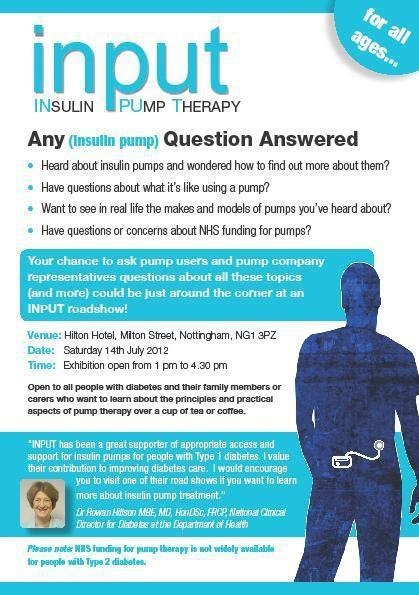
INPUT Insulin Pump Exhibitions 2012
Any (insulin pump) Question Answered

Have you heard about insulin pumps and wondered how to find out more about them? Do you have questions about what it’s like using a pump? Would you like to see in real life the makes and models of pumps you’ve heard about? Or do you have questions or concerns about NHS funding for pumps? Your chance to chat with pump users and pump company representatives about all these topics (and more) could be just around the corner at an INPUT roadshow!

Current Venues and Dates (further information on venues below). More dates and venues being added soon.

20120709-193317.jpg

Who: open to all people with diabetes and their family members or carers who want to learn about the principles and practical aspects of pump therapy over a cup of tea or coffee.

We have invited the following companies to exhibit:

Abbott (Freestyle Navigator)
Advanced Therapeutics (Dana & Dexcom)
Animas
Cellnovo
Medtronic
Roche
Ypsomed (OmniPod)

View my Blog about the superb previous Input Roadshow I attended in Luton.

www.mypump.co.uk
www.mypumpblog.com
****

Read Full Post »


Hi all,

Over the past few years I have been comuting to and from work by cycle which is about 4 miles so not too bad, well apart from when it is raining – cold – windy in fact I hate it (only joking).

20120531-205735.jpg

The one problem I have is my blood glucose levels plummet once iget to work or arrive home and I have tried numerous different products including dates and bananas which do definitely help. My problem is I am normally in a rush so prefer to pop something easy into my mouth and get going as soon as I can.

I am sure I am not the only person with Diabetes to have this issue and I have discovered jelly beans well Jelly Belly Beans which I must say do taste a little bit to nice as I struggle to put them down ha ha. A colleague of mine had read an article about people with Diabetes using jelly beans when running or swimming so I thought I would give it a try.

The great thing for me Is that each bean is approx 1g of carbohydrate and I tend to have between 10-15 beans before cycling which certainly does do the trick. What is do like is the fact they do not stay in my system for hours and hours but enough to cover my exercise which is usually about a 20 minute cycle. I have also tried Jelly Belly Sport Beans which do not taste quite so yummy but they do last far longer in your system and contain more carbohydrates per bean so better for longer bouts of exercise.

So down to my favourite flavours well all of them (Possibly not cinnamon). Cherry is so lovely, Top Banana is also a yummy bean and not forgetting Coconut.

Anyway I hope this has helped a little bit but if you have not tried Jelly Belly Beans before give them a try as they have helped me on more than one occasion but moderation is the key mmmmm.

Take care.

Andrew

http://www.mypump.co.uk
http://www.mypumpblog.com

Read Full Post »


Hi,

I can’t believe I have already been on an Insulin Pump for 4 years which means my current pumps warranty is up for renewal and at the moment I use an Animas 2020 pump which has been great.

So I am currently using the New Animas Vibe and hope my blog shares some information that you may find useful.

The Animas Vibe insulin pump and CGM system combines state-of
the-art Dexcom G4 Sensing technology with high-performance Animas pumping. That means it gives you the features Animas® pumps are known for, like waterproof durability¥, fine-tuned dosing and a high-contrast, self-illuminating colour display. It’s also designed to streamline the whole CGM experience for you, while giving you a full-colour view of how your glucose is behaving.

Animas Vibe is designed to give you a more complete picture of your glucose*. In addition, its packed with a unique combination of features designed to help you perform at your best.

20120405-213828.jpg

I didn’t realise that the pump needed to be replaced after 4 years and was a little worried that it may not be funded again but my hospital at High Wycombe are very good and sorted everything out for me very easily. I had been speaking with Caroline and Jill from Animas about renewing my Animas 2020 pump and that I would like to try the Animas Vibe with CGM which they arranged for me.

20120405-214055.jpg

My day started at High Wycombe Diabetes Centre with Caroline, Jill and Una (DSN) on Monday 30th January 2012, as you can imagine I was very excited indeed. My old pump was really difficult to read the screen which had put me off the Animas pump but what I discovered was that the screen on my old pump had burnt out so needed replacing (That was a relief and of course Animas said they would replace it). We went through the functions of the new Animas Vibe pump which is pretty much the same as the Animas 2020 apart from the fact it has CGM so I already had a head start, I love how easy the Vibe is to use and the fact you have a nice clear colour screen especially when looking at the CGM trend graph as pictured above. The team at Animas and Una were really great and went through everything with me especially on how to use the CGM and inserting it, I am just so frustrated that I can’t get funding from the PCT for CGM.

The actual insertion of the sensor is very easy and didn’t really hurt at all but more of a scratch which I was pleasantly surprised with, the sensors are recommended to be placed on your tummy and not on your back which makes it easier to insert. I did however have an issue with the first sensor which must have hit a blood vessel as a couple of hours later the CGM alarmed to say it was not working, I spoke to Animas who said to change the sensor as when I was with them it looked as though it had possibly hit a small blood vessel. The setting up of the CGM was very easy once the sensor had been inserted and I actually managed easily on my own. The sensor last for 7 days and alarms to let you know once the 7 days has finished, I like the fact you can wear it for 7 days without changing. The second sensor I used went in perfectly and I had no problems at all and again was like a sharp scratch so no pain really.

In regards to the results given by the CGM please remember that the CGM is really to be used to give trends rather than exact blood glucose readings, at the end of the day pricking your finger is still the most accurate. My results compared to finger prick testing were out by quite a way to be honest (not all the time though) but I had been suffering with a nasty chest infection for over a week then travelled to Sweden for a few days, this probably didn’t help with the results so I do hope I get another chance to test the CGM now I am well – we shall see. I have one sensor left as of today Monday 27th Feb and plan to use this after my next Diabetes check up and I will then have used my months trial and can upload my results for my DSN.

So would I use CGM if it was funded by the PCT – yes most definately as it made me feel a lot less worried whilst travelling knowing it would alarm if my BG level was too low.

I hope this helps and hopefully I will get the chance to try some more sensors while I am feeling well but watch this space. Please email or comment if you have any questions at all.

Many thanks

Andrew Borrett
www.mypump.co.uk
www.mypumpblog.com

Read Full Post »


INPUT Insulin Pump Exhibitions 2012
Any (insulin pump) Question Answered

Have you heard about insulin pumps and wondered how to find out more about them? Do you have questions about what it’s like using a pump? Would you like to see in real life the makes and models of pumps you’ve heard about? Or do you have questions or concerns about NHS funding for pumps? Your chance to chat with pump users and pump company representatives about all these topics (and more) could be just around the corner at an INPUT roadshow!

Current Venues and Dates (further information on venues below). More dates and venues being added soon.

20120315-214310.jpg

Luton – 14th April 2012
Chester – 19th May 2012

Time: 1pm – 4:30pm
Who: open to all people with diabetes and their family members or carers who want to learn about the principles and practical aspects of pump therapy over a cup of tea or coffee.

We have invited the following companies to exhibit:

Abbott (Freestyle Navigator)
Advanced Therapeutics (Dana & Dexcom)
Animas
Cellnovo
Medtronic
Roche
Ypsomed (OmniPod)

****

Luton – Saturday 14th April 2012
Venue: Hilton Garden Inn Luton North Hotel, LU2 8DD

***

Chester – Saturday 19th May 2012
Venue: Macdonald New Blossoms Hotel, Chester, CH1 1HL.

Read Full Post »


‘Feet first’ for diabetes patients

As a new study highlights major variations in diabetes-related foot amputation rates, Barbara Young, chief executive of Diabetes UK, explains why action is needed to cut rates of preventable amputations.

If I were to tell you about a place where thousands of feet were amputated every year as a result of poor healthcare, you would assume I was talking about somewhere in the developing world.

Well you’d be wrong. The fact is that here in the UK, thousands of people with diabetes have amputations every year.

Not only does an amputation dramatically reduce quality of life, but the likelihood of dying within five years is greater than for breast, bowel or prostate cancer.

And yet an estimated 80% of the 5,000 diabetes-related amputations a year in England could be prevented through better healthcare and improved management of the condition.

The fact that so many people are needlessly having their feet amputated is a national disgrace. And yet despite the large numbers, awareness of the problem is worryingly low even among people with the condition.

But it does not have to be like this.

The scandal of preventable amputations is one we hope to bring to an end with our Putting Feet First campaign. Over the next five years, we want the number of amputations in people with diabetes to reduce by 50%.

Raising awareness of the issue will be a big part of this.

‘Insufficiently thorough’
The 2.8m people in the UK who have been diagnosed with diabetes should know how important it is to manage blood glucose levels, cholesterol and blood pressure well, as well as checking feet regularly and making sure shoes fit properly.

But they also need to know what healthcare you should expect – because all too often it falls short of what people are entitled to.

Firstly, everyone with diabetes should get an annual foot check.

These are important for identifying problems at an early stage, but many thousands of people are not getting them. And when they are being done, they are sometimes insufficiently thorough.

I have even heard of foot checks where the patient is not even asked to take their shoes and socks off!

Also, at the end of the check patients should be told what their risk status is, so if this does not happen then you should ask.

Secondly, if you have a foot ulcer then you need to be seen by a diabetes specialist foot care team as soon as possible.

It should certainly be within 24 hours, as an ulcer can deteriorate in a matter of hours.

Some areas are already doing well in terms of getting diabetes-related ulcers referred to these specialist teams within 24 hours.

But there are also poorly-performing areas where this does not happen.

Tragically, that omission can be the difference between someone keeping their foot and losing it.

If people with diabetes are not offered this level of care, they should insist on it and complain if they don’t get it.

But the point is that decent healthcare is something everyone should get as a matter of course.

For this to happen, we need to address the reason that large swathes of the country are doing so badly.

We know from speaking to health professionals that many of them are desperate to give people with diabetes the best possible foot care but feel unable to do so under the existing system.

This is why the government needs to show leadership on this issue by insisting that all areas of the country offer the same standard of care that is already available in the best areas at the moment and monitoring and managing standards to ensure that they are being delivered.

This greater political will is the only way to bring an end to the tragic postcode lottery of amputations and in doing so create an NHS that really does put feet first for people with diabetes.

Read Full Post »


SUNDAY, 26 FEBRUARY 2012
The Advanced Technologies and Treatments for Diabetes conference 2012 – a great blog from Anna at Insulin Independent

The 7th -10th February 2012 saw the arrival of the international event known as the Advanced Technologies and Treatments for Diabetes (ATTD) conference, which I was lucky enough to be able to attend as a representative of INPUT and funding from Dexcom to assist INPUT in the work they do. The ATTD is a worldwide conference where research outcomes at the very forefront of technological advance are presented. Being only 5 years old it is still in its fledgling years, but growing noticeably each year. Although I was not at last year’s event, I am informed that there were around 1000 attendees. This year, there were 1600 and I’m sure there are many more who would have attended given half a chance. It is aimed at diabetic professionals (or professional diabetics, in my case) mainly being consultants, nurses and diabetes educators, although the odd advocacy service pop up here and there too!
Being an insulin pump user, a diabetes advocate and a bit of an inquisitive old lass, it is always of great interest to me to see where this diabetes technology beast is heading. We hear terms like ‘Artificial Pancreas’ and ‘non-invasive glucose monitoring’ thrown about on an almost daily basis now and yet many people in the diabetic community feel these are creatures of myth and seem to hold a ‘that’ll be the day’ attitude towards them. So to be involved in a conference where this research is being presented was an honour and frankly, somewhat of an eye-opening occasion for me. .
Clearly it would be impossible to go through each of the presentations, symposiums and workshops in detail. Not in the least because my less than scientific mind would never be able to recall all the details for you. But perhaps giving you an idea of the things that caught my eye would be of use.

One of the stands in the exhibition which I kept circling in a slightly cautious way, was that of C8 Medisensors. In case you haven’t heard of them (I hadn’t), they are bringing to market a non-invasive glucose monitor that uses Raman Spectroscopytechnology which for those of you who don’t speak ‘medical journal’, is effectively a light that shines through the skin and identifies how many glucose particles there are in the interstitial fluid. Phew, mouthful ay. Well, according to early tests they are showing promising results, although the last test only involved 6 people. I would need to see a significant higher amount before I would be convinced it would rival the likes of Dexcom 7+ and Medtronic Enlite. Now we all remember the success of previous non-invasive systems such as the Glucowatch, the remnants of which remains burned on the skin cells of countless diabetics who had the misfortune of using it. But this was impressive. In its current form it is a bit on the ‘chunky’ side, and is held around the midriff with a tight neoprene band. But for those parents out there who hate the feeling of piercing their children’s skin with countless needles they have to face, I think this could be a contender. If, and only IF, they come good in clinical trials. Watch this space.

For quite some time I have been aware that in order to avoid post meal spikes I need to bolus 30 minutes before each meal, otherwise those spikes just creep in a couple of hours later. But we also know that each diabetic is different and we are told all the time to find our own way. So I was very interested in a lecture about bolus times in children using insulin pump therapy. In the results being demonstrated to the audience, the message was that 15 minutes was the optimum pre-meal bolus time to avoid those spikes. In addition to this the study, called “Fine Tuning of Insulin Pump Therapy in children with type 1 diabetes: The importance of bolus timing and type” demonstrated that making the most of dual wave boluses and separating correction boluses and meal boluses, would make all the difference. They found that with mediterranean food for example, boluses were split 70% straight away and 30% over 4 hours, while Pizza was 30% straight away and 70% over 6 hours. They also highlighted that the results of their study showed that when blousing for a meal, any correction bolus being included with the meal bolus, should be separated by 15 minutes, and that this would bring glucose down to normal via the fastest route. Fascinating stuff for me, someone who has always struggled to get my head about a dual waver

One of the key lectures for us to attend included INPUT’s very own Lesley Jordan taking to the stage. Lesley has been involved in a pioneering project to trial the Accu Chek Diaport, an intra-peritoneal (goes into the peritoneal cavity in the abdomen) infusion site which is permanently fixed (as long as the host wants it, that is). It is surgically implanted and regularly maintained and allows for insulin to be much faster acting (see number 3 on my list), removes the worry of hitting a bad site and means much better control. It may not be for everyone as it is surgically implanted but for those with site problems leading to frustration and poor control it provides a very useful tool in helping achieve control over their condition and maintain use of an insulin pump effectively. Lesley has been one of the Diaport ‘guinea pigs’ and thanks to feedback from her, the new and improved second generation is ready to launch.

There were also stands demonstrating the Omnipod, the Accu-Chek Combo, the Medtronic Veo and my particular favourite of the moment, the Cell-Novo. I had the chance to catch up with some old friends from Medtronic, meet new ones at Roche and Cell-Novo and had a chance to thank Dexcom for supporting INPUT and in a round about way, helped me attend such an inspiring event.

Read Full Post »


Sanofi to conduct a survey of parents who have teenagers and young adults with type 1 diabetes

20120118-204118.jpg

Do you have a son or daughter aged between 13 and 23 who has type 1 diabetes? Are you ever concerned about their health and diabetes management now that they are becoming more independent?

Sanofi is conducting a survey of parents of teenagers and young adults (aged between 13 and 23) who have type 1 diabetes to highlight any worries they may have for their children’s health and diabetes management. The survey will be used to support the launch of a new, blood glucose monitor (BGM).

Please find a link to the survey here: https://www.surveymonkey.com/s/flyingthenestfeature

If you have any questions, please get in contact with Claire Nicholson (tel: 020 7025 6524; email: claire.nicholson@redconsultancy.com)

Read Full Post »


A message from John Davis
Posted on January 6, 2012 by inputadmin www.input.me.org

John Davis

20120110-213301.jpg

I have been overwhelmed by the response to the announcement that I am to receive an MBE for services to diabetes in the New Year’s Honours list. I had no idea of the depth of feeling there is regarding my work with INPUT. It has been a humbling experience and I thank you all for your messages of congratulations.
Obviously it is a great honour and privilege to be recognised in such a way, and I am very proud to receive it. I believe that it is acknowledgment that, at last, insulin pump therapy has received the recognition that it deserves.

However, it could not have been achieved without the help and support of all of you out there in the “pump community.” There have been many who have contributed over the years and it is not possible to mention them all, but I must pay special tribute to Jackie Jacombs of the UK CWD Advocacy Group, who has been invaluable help for so long, and to Lesley Jordan, who has now taken over the reins of INPUT upon my retirement.

I would also like to give special thanks to;
Joan Everett, DSN at Royal Bournemouth Hospital. It was with Joan’s help that I started INPUT in 1998, back then there were only 180 pump users in the UK. Now there must be around 20,000.
Dr Fiona Campbell, who invited me to Leeds to make a presentation on insulin pumps to her Yorkshire colleagues. I took 3 children and their parents with me. I let the children tell their own story of life with a pump. It was after this presentation that Fiona decided to start using pumps in her clinic.

Finally, Prof John Pickup, a great man, who has not had the recognition he deserves for all his work in developing the pump. He gave me invaluable help in the early years.
It can be frustrating to be ahead of the curve. It took me several years of lobbying to get influential organisations and personalities in diabetes care in the UK to take pump therapy seriously. It is satisfying that we are now all going in the same direction.

Thank you

John Davis MBE

Read Full Post »

« Newer Posts - Older Posts »